Turn Voice Notes Into Production-Ready Content with Local AI Transcription
Learn how to use a local AI transcription tool, to transform voice notes into clean production-ready content, technical documentation, blog posts, and operational knowledge.
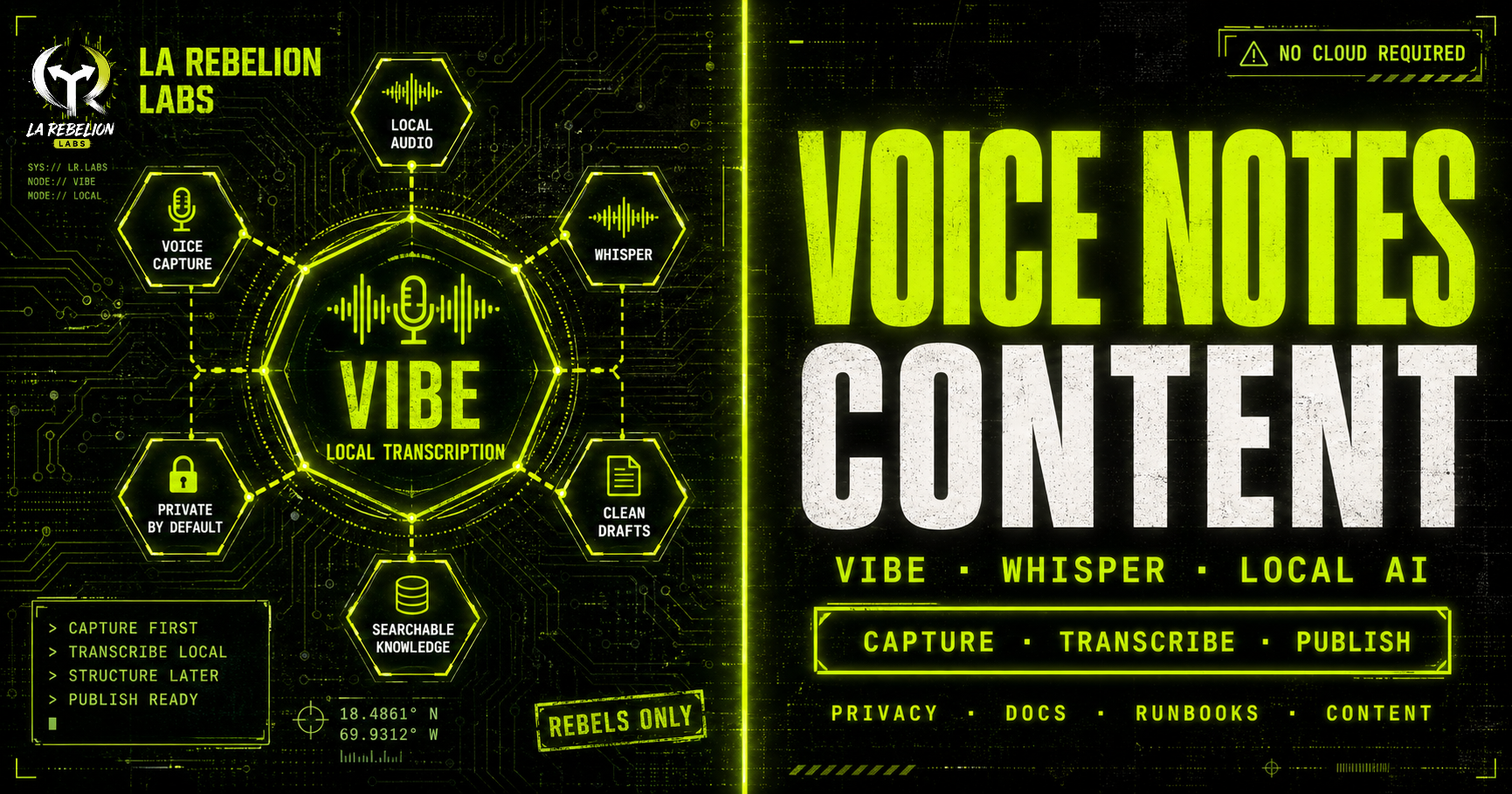
Stop Losing Great Ideas: Turn Voice Notes Into Production-Ready Content with Local AI
Every technical founder, architect, DevOps engineer, or creator eventually hits the same problem:
You have brilliant ideas... at the worst possible time.
Driving. Walking. Cooking. At the gym. In the middle of debugging something.
And by the time you sit in front of your laptop?
The idea is gone.
Or worse: You remember just enough to know it was good.
That used to happen to me constantly.
As someone building projects like HAPI MCP, My Clawster, and multiple content platforms, I realized something important:
The bottleneck is not ideas anymore.
The bottleneck is capturing and operationalizing them fast enough.
That is why I started experimenting with local AI transcription workflows. I was struggling to capture my best thinking and turn it into reusable content. I needed a way to quickly transcribe voice notes and then clean them up for production use.
I found a tool that completely changed how I capture technical thinking, content ideas, architecture discussions, and operational knowledge. It is called Vibe, and it is a local-first AI transcription tool powered by Whisper models!
Why Local AI Transcription Matters More Than People Think
Most people think transcription tools are only for meetings or podcasts.
That is massively underestimating the value.
If you are a:
- Developer
- Platform engineer
- Technical Product Manager
- Founder
- Content creator
- DevOps engineer
- Architect
- AI builder
...your voice notes are probably one of your most valuable assets. If you don't capture them, they disappear. Because your best insights rarely happen while sitting perfectly organized in Notion or any other note-taking app.
They happen in motion.
The challenge is turning:
- messy thoughts
- fragmented explanations
- troubleshooting sessions
- architecture reasoning
- random innovation sparks
...into structured, reusable, searchable material.
That is where local AI tools like Vibe become game changers.
What Is Vibe?
Vibe is a local-first AI transcription tool powered by Whisper models.
What makes it special?
Key Benefits
1. Local Processing
Your audio stays on your machine.
This is huge for:
- enterprise environments
- regulated industries
- confidential architecture discussions
- customer-sensitive information
- airgapped workflows
- zero-trust environments
As someone who works heavily with enterprise and airgapped systems, this immediately caught my attention.
2. Surprisingly Accurate
Even with technical language.
I tested it with:
- Kubernetes concepts
- MCP terminology
- API-first discussions
- infrastructure conversations
- architecture brainstorming
And the results were impressive.
Especially compared to traditional cloud transcription services.
3. Perfect for "Thinking Out Loud"
This is the killer feature.
You do not need polished audio.
You can literally:
- record yourself walking
- brainstorm ideas verbally
- explain architectures casually
- dump raw thoughts
Then later:
-
clean the transcript
-
organize ideas
-
transform them into:
- blog posts
- PRDs
- LinkedIn posts
- tutorials
- technical documentation
- operational runbooks
My Real Workflow Using Vibe
This is where things become practical.
Here is my current workflow.
Step 1 — Record Everything
I stopped trying to "remember later."
Instead:
- I record quick audio notes
- architecture thoughts
- debugging discoveries
- product ideas
- content hooks
- system designs
Sometimes they are 30 seconds.
Sometimes 15 minutes.
The important part: Capture first. Organize later.
Step 2 — Transcribe Locally with Vibe
Using Vibe, I generate transcripts locally.
This gives me:
- searchable knowledge
- reusable technical thinking
- content seeds
- documentation drafts
And because it is local-first:
- no vendor lock-in
- no API costs
- no privacy concerns
- no token usage explosion
That matters more than people realize.
Especially if you are building an AI-heavy workflow.
Step 3 — Clean the Transcript
The raw transcript becomes the foundation.
Then I:
- remove filler words
- improve structure
- split ideas into sections
- identify hooks
- extract insights
This transforms chaotic voice notes into structured knowledge.
Step 4 — Production-Ready Material
This is where the magic happens.
One voice note can become:
| Input | Output |
|---|---|
| Random architecture rant | Technical blog post |
| Operational troubleshooting | Internal documentation |
| Product brainstorming | PRD draft |
| Walking idea | LinkedIn content |
| AI workflow explanation | YouTube script |
| MCP concept discussion | Educational article |
This dramatically increases leverage.
Why This Workflow Is Powerful for Technical Professionals
Most engineers underestimate something:
Your thinking process itself is valuable.
Not just the final code.
Your:
- debugging logic
- architecture decisions
- tradeoff analysis
- system reasoning
- operational discoveries
...all contain valuable intellectual property.
The problem is: Most of it disappears.
Voice-to-knowledge workflows solve that.
Local AI Is Quietly Becoming a Superpower
There is another important trend happening here.
More creators and engineers are moving toward:
- local AI
- local LLMs
- offline tooling
- private workflows
- edge AI
- self-hosted productivity
Why?
Because relying entirely on SaaS AI platforms creates friction:
- recurring costs
- privacy concerns
- API dependency
- vendor lock-in
- unpredictable pricing
- latency
Tools like Vibe represent a different direction:
AI that works for you locally.
And honestly?
I think this trend is only getting started.
OK, now you may be thinking:
How to Install Vibe
You can find the official project here:
The repository contains installation instructions for multiple platforms.
The setup is relatively straightforward.
Once installed:
- Record your audio
- Feed it into Vibe
- Generate transcript
- Clean the content
- Repurpose it into production-ready material
Simple idea. Massive leverage.
Real Use Cases for Engineers and AI Builders
Technical Documentation
Explain systems verbally instead of manually typing everything from scratch.
Incident Retrospectives
Record your debugging journey immediately after solving an issue.
You will capture insights that normally disappear.
Content Creation
Transform voice notes into:
- blogs
- LinkedIn posts
- tutorials
- YouTube scripts
- newsletters
MCP and Agent Workflows
Voice notes can become:
- prompts
- skills
- workflow instructions
- operational procedures
- agent memory seeds
This becomes incredibly powerful when combined with AI agents.
The Bigger Lesson Here
The real value is not transcription.
The real value is:
Converting transient thinking into reusable systems.
That is the actual unlock.
Most people consume AI.
Builders operationalize it.
Final Thoughts
I genuinely think workflows like this are underrated.
Especially for:
- technical founders
- engineers
- creators
- architects
- AI builders
The ability to rapidly transform ideas into structured knowledge creates an unfair advantage over time.
And because tools like Vibe run locally, they align perfectly with:
- privacy
- ownership
- AI independence
- enterprise requirements
- airgapped workflows
If you constantly record ideas on the go, this tool is absolutely worth exploring.
Resources
Bonus: Automate the Workflow with Skills
After experimenting with this workflow, I created a Skill to automate parts of the process:
- transcript cleanup
- formatting
- content preparation
- production-ready transformations
You can download them here:
👉 [DOWNLOAD LINK HERE]
Go Rebels ✊🏼