Model Context Protocol (MCP) — Is it a protocol or a contract?
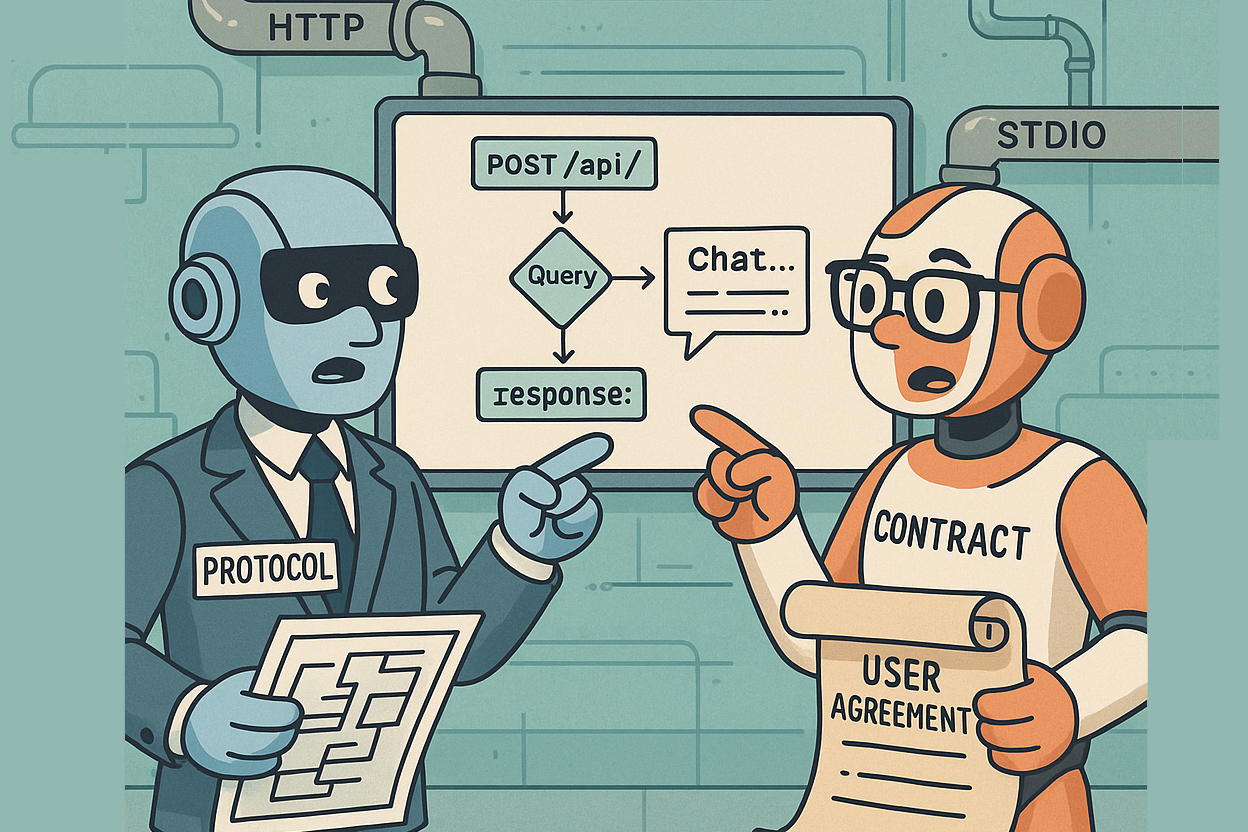
MCP borrowed its shape from the Language Server Protocol, but its real value is the contract. Updated for 2026, when MCP went stateless and agents got their own contracts with A2A Agent Cards.
:::info Updated October 2026
When I wrote this in August 2025, "MCP is a contract" was a hunch. Since then, the specification itself has moved in that direction: the 2026-07-28 revision removed the initialize handshake and protocol-level sessions entirely. I've added what changed, and what it means, at the end of each section.
:::
Since its introduction, MCP has sparked fascinating discussions across developer communities, with both proponents and opponents.
When I first discovered MCP in late November 2024, I was immediately intrigued by its potential. It seemed like the missing piece in how we communicate with systems using natural language, a problem I was already trying to tackle with my CLI tools gyat and hapi. However, those tools worked algorithmically, with deterministic workflows; they couldn't systematically interact with AI models.
Anthropic's MCP caught my attention because it appeared to offer a solution: a way to standardize natural-language communication with systems, for developers and users alike. Initially, I saw MCP as a protocol that could bridge the gap between human language and machine comprehension.
My journey with MCP
I immediately began experimenting with MCP, integrating it into my tools and workflows. The simplicity of adding tools to Claude's desktop interface was compelling; it felt like a natural evolution beyond traditional APIs and protocols.
There was a catch, though. The initial learning curve was steep, and troubleshooting was hard. I wanted to help others facing the same struggles by making MCP more accessible without requiring deep technical understanding.
Through writing about my experiences, my understanding evolved along with the specification. A pivotal moment came when MCP introduced Streamable HTTP (protocol revision 2025-03-26) as a transport. That shift helped me realize that MCP isn't purely a protocol; it's fundamentally a contract that emphasizes interaction semantics rather than data-transfer mechanics.
Since my gyat and hapi CLI tools were designed to be API-first, MCP fit right in: it doesn't just define how systems communicate, it defines how they should behave.
The LSP connection: understanding MCP's roots
To understand what MCP is, let's look at its foundation. Do you recognize this JSON structure?
Content-Length: ...\r\n
\r\n
{
	"jsonrpc": "2.0",
	"id": 1,
	"method": "textDocument/completion",
	"params": {
		...
	}
}

What about these TypeScript interfaces?
interface RequestMessage extends Message {
	/**
	 * The request id.
	 */
	id: integer | string;

	/**
	 * The method to be invoked.
	 */
	method: string;

	/**
	 * The method's params.
	 */
	params?: array | object;
}

interface ResponseMessage extends Message {
	/**
	 * The request id.
	 */
	id: integer | string | null;

	/**
	 * The result of a request. This member is REQUIRED on success.
	 * This member MUST NOT exist if there was an error invoking the method.
	 */
	result?: LSPAny;

	/**
	 * The error object in case a request fails.
	 */
	error?: ResponseError;
}
No, it isn't MCP. This is the Language Server Protocol (LSP), which standardizes how development tools talk to programming-language servers. LSP lets editors and IDEs offer code completion, linting and refactoring across languages, without language-specific logic in each tool.
The lifecycle message flows of LSP and the original MCP were strikingly similar:
sequenceDiagram
  participant Client
  participant Server

  Client->>Server: Initialize
  Server->>Client: Initialized
  Client->>Server: Register Capability
  Client->>Server: Unregister Capability
  Client->>Server: Set Trace
  Client->>Server: Log Trace
  Client->>Server: Shutdown
  Client->>Server: Exit

Why LSP matters for understanding MCP
LSP revolutionized software development by solving an integration problem. Before LSP, supporting code intelligence meant M × N integrations: M languages for N editors, each one expensive and fragile.
LSP introduced a universal interface. Once a language server was built, any LSP-compliant editor could use it.
Sound familiar? That's exactly what MCP does for AI: once an API is exposed as an MCP server, any compliant client can use it without custom logic for each client.
:::note What changed in 2026
MCP has since parted ways with LSP's lifecycle. In the 2026-07-28 revision, the initialize / notifications/initialized handshake is gone, and so are protocol-level sessions and the Mcp-Session-Id header. Every request now carries its own protocol version and client capabilities in _meta, and servers advertise what they support through a new server/discover request. MCP kept LSP's best idea, one interface for many clients, and dropped the stateful ceremony.
:::
The strategic launch: lucky or smart?
Timeline:
- MCP SDK made public on GitHub: October 23, 2024
- Claude desktop released: October 31, 2024
Much of the early buzz around MCP came from Claude desktop, the first MCP client. Anthropic made a smart move by recognizing LSP's potential and applying the same principles to AI model interactions.
The choice of stdio as the first transport was controversial, but it was strategically sound: lightweight and direct, ideal when client and server run on the same machine, which was the case for Claude desktop and the first MCP servers.
Understanding stdio
stdio (standard input/output) comes from the C runtime and UNIX-like systems, and consists of three standard streams:
- stdin (0): input
- stdout (1): output
- stderr (2): errors
They're just file streams, attached to terminals, pipes or redirects. stdio is a transport for higher-level protocols.
Analogy: if HTTP is postal mail, stdio is passing notes through a tube: simpler and faster when sender and receiver sit side by side.

The community's push toward HTTP made sense: it's familiar, widely supported, and comes with headers, status codes and content negotiation. For me, Streamable HTTP in revision 2025-03-26 was transformative.
:::note What changed in 2026 Both transports remain standard, and the 2026-07-28 transports page states it plainly: "Protocol semantics are identical on every transport." On Streamable HTTP, each message is one HTTP POST to a single MCP endpoint. A transport is now explicitly just a binding. The meaning lives above it, in the contract. :::
MCP as a contract, not a protocol
This brings us to the core insight: MCP is not just another protocol; it's a semantic layer that enables intelligent API interactions. It lets agents understand not just the data, but the intent and context behind it.
Consider this question: where do Swagger/OpenAPI (OAS) fit in a networking model such as OSI?
They don't fit neatly, and that's fine. Swagger/OAS isn't a protocol in the traditional sense; it's a contract that defines how systems should interact.
Why Swagger/OAS doesn't fit the OSI model
The OSI model describes how data moves across networks, from the physical wire (layer 1) to applications (layer 7).
Swagger/OAS, by contrast:
- doesn't handle transport (layer 4);
- doesn't define sessions (layer 5);
- isn't concerned with encoding (layer 6);
- isn't a runtime application (layer 7).
Instead, it:
- describes APIs: endpoints, parameters, responses and authentication;
- acts as metadata for client-service interactions over HTTP.
That's meta-communication, a contract, not transmission.
The "layer 8" concept
I'd place Swagger in layer 8: "people, policies and planning", where developers, product managers and architects live. It's about human agreement, specification and negotiation of service interfaces.
Analogy: if the OSI model is a road system:
- Layers 1–4 are the asphalt, traffic rules, intersections and cars.
- Layers 5–7 are the drivers, GPS and apps that send and receive instructions.
- Swagger/OAS is the roadmap and city-planning documentation that tells drivers and planners how the roads should be used.
MCP operates in the intent layer
In intent-based systems, like MCP or autonomous agents, specifications such as Swagger or gRPC play a central role:
- declaring intent;
- providing machine-readable contracts;
- powering automation, code generation, testing and governance.
In modern cloud-native and AI-centric architectures, these specifications live in the intent and control plane, sometimes called layer 8+ or "layer 9: governance and compliance".
Summary: contract vs protocol
| Aspect | OSI equivalent | Why it's different |
|---|---|---|
| Describes APIs over HTTP | Above layer 7 | It's metadata, not data |
| Exists at design time | Layer 8 (people) | It's a contract, not a protocol |
| Used by developers and tools | Layer 8/9 | Focused on agreement and automation |
| Doesn't transmit data | Not in OSI | Doesn't live in the data plane |
Key insight: Swagger/OAS is what developers and machines use to agree on how to communicate, but it doesn't do the communicating itself.
In the same way, MCP's value lives in "layer 8", the realm of contracts, conventions and collaboration. That's not a limitation; it's the evolution from "transporting data" to "understanding and automating intent".
:::note What changed in 2026
The evidence got stronger. A stateless MCP request is a self-contained message: which tool, which arguments, which protocol version. That's very close to a REST call described by an OpenAPI operation. In practice, the HAPI CLI builds MCP tools directly from an OpenAPI contract: the operationId becomes the tool name, the parameters become its input schema, and GET operations are marked read-only. See You don't need to implement MCP servers for the real output.
:::
Contracts all the way up: agents get business cards
There's a new layer-8 citizen since I first wrote this. MCP connects an agent to its tools. The Agent2Agent (A2A) protocol, an open-source Linux Foundation project contributed by Google, connects agents to other agents, and its documentation describes it as complementary to MCP.
How do agents find each other? Through an Agent Card: a public JSON document that declares the agent's name, what it does, where to reach it, and the skills it offers. That's not transport, it's a contract. The pattern repeats one level up: OpenAPI for APIs, MCP for tools, Agent Cards for agents.
Why this matters: MCP's real value
Anthropic's insight was building on this intent-layer idea to make AI interactions more intuitive. MCP wasn't just another specification; it was a way to make AI practical.
When I finally understood MCP as a contract rather than a protocol, everything fell into place. The 2026 revision feels like the specification reaching the same conclusion.
Looking forward: MCP in the enterprise
In regulated industries such as banking, healthcare and defense, contracts are paramount. An explicit semantic layer maps directly to compliance needs:
- Audit trails: every tool call is a named action with typed arguments, so it can be logged with its context.
- Policy enforcement: behavior hints such as
readOnlyHintanddestructiveHintlet clients and gateways treat reads and writes differently. - Authorization: MCP now has an Authorization specification for HTTP, based on OAuth 2.1.
- Version control: date-based protocol revisions, plus your own contract versions, managed with GitOps like any other code.
Conclusion
What began as curiosity about a new protocol became a deeper understanding of how AI systems can better serve people. MCP isn't just about data exchange; it's about meaningful, contextual interactions between people, AI and systems.
By treating MCP as a contract that lives in the intent layer, we can build AI integrations that are more reliable, easier to maintain and more robust. It's not about the transport; it's about the semantic agreement that enables intelligent automation.
That's what we build at La Rebelion Labs with the HAPI MCP stack: API-first MCP, from the contracts you already have. Read the documentation to get started.
Further reading
- LSP specification
- Model Context Protocol: changes in 2026-07-28
- MCP transports (2026-07-28)
- Agent2Agent (A2A) Protocol
- HAPI MCP documentation
This post was brought to you by someone who once thought MCP was just another protocol, and is now convinced it's a contract that unlocks smarter, more reliable AI integrations. The specification seems to agree.
Go Rebels! ✊🏽