OpenAPI + MCP + Arazzo = The Formula for AI Automation
What’s possible when you mix OpenAPI, the Model Context Protocol (MCP), and the Arazzo Specification?
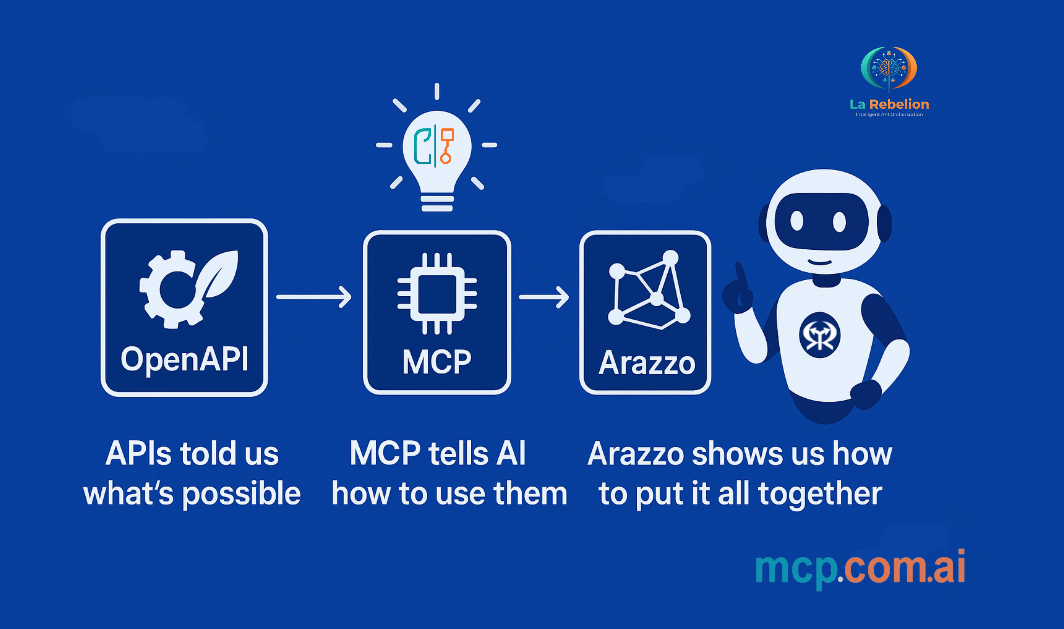
What’s possible when you mix OpenAPI, the Model Context Protocol (MCP), and the Arazzo Specification?
In one word: everything.
We’re standing on the edge of a new era in AI automation—where workflows that once took weeks to wire up across APIs, SDKs, and custom scripts could soon be described, orchestrated, and executed seamlessly.
Why This Formula Matters
The combination of OpenAPI, MCP, and Arazzo is transformative for AI-powered automation:
-
OpenAPI provides a universal language to describe APIs—a trusted blueprint that ensures clarity and consistency across systems.
-
MCP introduces a native protocol for LLMs to interact with APIs directly—eliminating hacks and workarounds. It acts as the bridge, enabling seamless communication between AI agents and APIs.
-
Arazzo serves as the orchestration layer, defining workflows as portable, spec-driven processes. It’s the glue that binds everything together.
This synergy means you’re no longer confined to a single ecosystem and vendor lock-in like n8n, LangFlow, Flowise, or traditional engines like Temporal or Camunda. With Arazzo as the workflow layer, you can orchestrate processes across any system while maintaining the confidence and reliability of an API-first approach.
By leveraging these standards, you unlock a future where AI workflows are not only powerful but also portable, scalable, and ecosystem-agnostic.
The result? An LLM can take “Place an order for SKU123” and autonomously execute the workflow across services with full visibility.
MCP + OpenAPI in Action
Imagine you’ve got an API for order processing:
sequenceDiagram
    participant User
    participant LLM as LLM (via MCP)
    participant OrderAPI as Order Processing API (OpenAPI)
    User->>LLM: "Place order for SKU123"
    LLM->>OrderAPI: MCP call to create order
    OrderAPI-->>LLM: Order confirmation
    LLM->>User: "Order placed successfully!"
Adding Arazzo to the mix
Now, let’s say placing an order involves multiple steps: checking inventory, processing payment, and sending a confirmation email. Here’s how Arazzo orchestrates that process in a structured, spec-driven way:
arazzo: 1.0.0
info:
  title: AI Order Workflow
  version: 1.0.0
workflow:
  - step: checkInventory
    description: "Verify if the requested SKU is available in inventory."
    call:
      operationId: getInventory
    next: [createOrder]
  - step: createOrder
    description: "Create an order for the requested SKU after inventory confirmation."
    call:
      operationId: postOrder
    next: [sendConfirmation]
  - step: sendConfirmation
    description: "Send a confirmation email to the user after the order is successfully created."
    call:
      operationId: postEmail
This YAML specification defines a clear, step-by-step workflow for placing an order. Each step is described with its purpose, the API operation it calls, and the next step(s) in the sequence. This makes the workflow not only executable but also easy to understand and maintain.
How does this play out in practice? Here’s the sequence of interactions visualized:
sequenceDiagram
    participant User
    participant LLM as LLM<br>(via MCP Client)
    participant Arazzo as (Arazzo)<br>Workflow Engine
    participant InventoryAPI as Inventory API (HAPI)
    participant OrderAPI as Order Processing API (HAPI)
    participant EmailAPI as Email Service API (HAPI)

    User->>LLM: "Place order for SKU123"
    LLM->>+Arazzo: Start order workflow
    Arazzo->>InventoryAPI: Check inventory for SKU123
    InventoryAPI-->>Arazzo: Inventory available
    Arazzo->>OrderAPI: Create order for SKU123
    OrderAPI-->>Arazzo: Order created successfully
    Arazzo->>EmailAPI: Send confirmation email
    EmailAPI-->>Arazzo: Email sent successfully
    Arazzo-->>-LLM: Order workflow completed
    LLM->>User: "Order placed successfully!"
In this diagram:
-
The User initiates the process by requesting to place an order in natural language.
-
The LLM, using the MCP protocol, delegates the workflow execution to the Arazzo Workflow Engine.
-
Arazzo orchestrates the steps:
-
It first checks the inventory via the Inventory API.
-
If inventory is available, it proceeds to create the order using the Order Processing API.
-
Finally, it sends a confirmation email through the Email Service API.
-
-
Once all steps are completed, Arazzo reports back to the LLM, which informs the user of the successful order placement.
Because this workflow is defined in a spec-driven manner, it is portable across platforms like n8n, LangFlow, Temporal, or Camunda. Arazzo ensures that the logic remains consistent and reusable, regardless of the underlying execution engine.
This approach not only simplifies complex workflows but also makes them scalable, maintainable, and transparent—key factors for building robust AI-powered automation systems.
The real business impact
Executives care about cost, speed, and risk. Developers care about standards and reusability. Operators care about observability and maintainability.
This formula speaks to all of them:
-
Faster integration = faster time-to-market
-
Standards = reduced tech debt and vendor lock-in
-
Clear orchestration = predictable, auditable AI-powered workflows
It’s not just about building cool AI toys—it’s about building resilient, future-proof business systems.
Why I’m excited about Arazzo
The Arazzo Spec feels like the orchestration layer AI has been waiting for. Imagine telling your AI agent not just what API to call (that’s OpenAPI), or how to connect to it (that’s MCP), but also why, when, and in what order.
That’s Arazzo. That’s AI workflows as code.
This opens the door to something bigger: cross-platform automation without silos.
Where the HAPI Stack fits
The HAPI Stack for MCP explores how these standards—OpenAPI, MCP, and now Arazzo—can accelerate the API-First + AI-Orchestration future. Instead of reinventing the wheel every time, we’re building with standards-first tooling that makes it easier to go from idea → workflow → production.
What is your take?
I’d love to hear your take
-
Do you see Arazzo becoming the universal glue for workflows?
-
How do you imagine AI agents benefiting from an OpenAPI + MCP + Arazzo formula?
-
What opportunities—or challenges—do you see for your teams or projects?
Check out the Arazzo spec here: Arazzo Latest Draft and the deep dive here: Swagger Blog.
Let’s spark a conversation about what’s next—because this might just be the foundation of AI-native automation.
Go Rebels! ✊🏽