REA on a Token Diet
Measure and cut the tokens Reverse Engineering Anything puts in your AI agent's context, keep agents working while big binaries decompile, and see which optimizations are still open proposals.
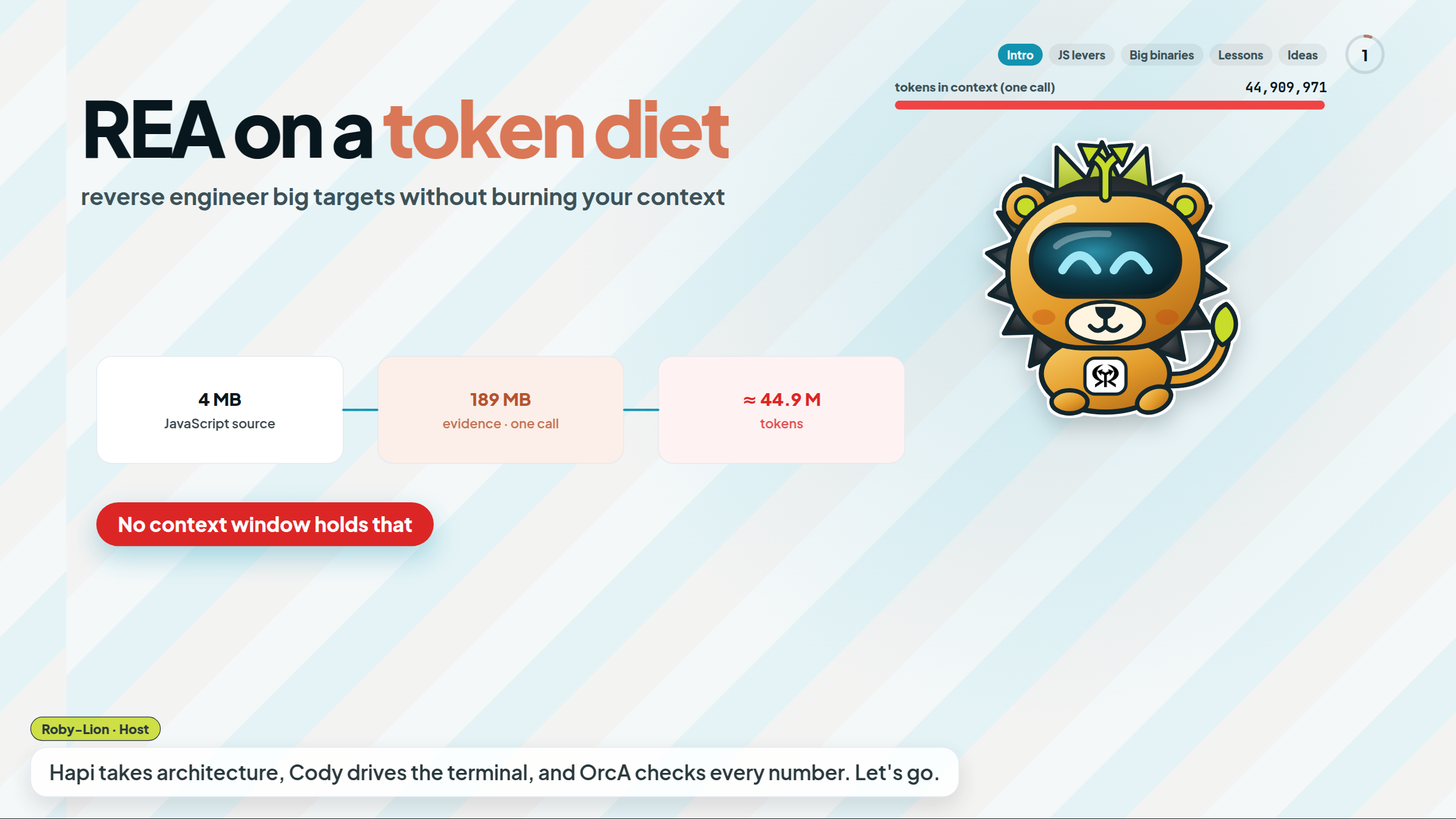
REA lets your AI agent reverse engineer anything, and it can produce far more evidence than any context window holds. We ran one full analysis of a 4 MB JavaScript folder and got 189 MB of evidence, about 45 million tokens by REA's own counter. This guide shows how to cut that by orders of magnitude with features REA already ships, how to handle big native binaries without leaving your agent stuck waiting, and which ideas are still proposals.
Three different costs
- Tokens: everything the model reads, including big tool results, repeated calls, errors, and retries.
- Latency: the time an engine such as Ghidra needs to import and analyze a binary.
- Reasoning: the model deciding small steps that ordinary software could handle.
Waiting for Ghidra doesn't burn tokens by itself. Polling, giant replies, and repeated analyses do.
Measure first
Every REA command accepts --token-count, which prints the size of the output instead of the output itself. The token count is REA's CLI counter, not your provider's bill. Your real cost also depends on the client, caching, and the number of turns.
All measurements below use REA 6.5.0 on the open-source LibreChat api/ folder (470 JavaScript files). The repo's token-diet-bench.sh reproduces them on any project.
| What | Result |
|---|---|
Full analyze-javascript-application | 74 s · 189 MB · ≈ 44,909,971 tokens |
| Summary view of the same evidence | 10,485 bytes · 2,344 tokens |
| One page (32 modules) | 2,793 tokens |
Trace /refresh, both directions | 4,524 nodes · ≈ 4.7 M tokens · 29 s |
Trace, incoming only | 11 nodes · 10,465 tokens |
Trace, outgoing only | 1 node · 1,351 tokens |
Trace summary with --filter-output | 60 tokens |
--source-path server/routes/auth.js | 5.7 s · 8.1 MB · ≈ 1.94 M tokens |
Levers you can use today
Summary first. Save the evidence once, then project a view:
rea analyze-javascript-application /path/to/app --json > evidence.json
jq -c '{source: {kind: "inline", evidence: .}, view: {kind: "summary"}}' evidence.json > view.json
rea inspect-analysis-view view.json
To page through modules, use {"kind": "page", "collection": "modules", "offset": 0, "limit": 32}.
Filter and cap. --filter-output selects key paths, --token-limit caps the output, and --token-offset reads the next slice. TOON, the default CLI format, is already compact.
Choose the trace direction. trace-application-feature accepts outgoing, incoming, or both. A broad bidirectional trace can pull in unrelated relationships.
Scope, then still use views. --source-path cuts analysis time, but the result can still be large. Combine it with views and filters.
The MCP safety net. When a result doesn't fit one MCP message, REA returns resource_constraint with a reference to the evidence it retained. Open that reference with inspect_analysis_view (summary, section, or page), or export it with export_evidence_bundle. For native function evidence, the error includes a ready-to-call request for the first pseudocode page. get_evidence_bundle with detail: "summary" and filters lists stored records without their payloads. Never re-run an analysis only because the reply was too big.
Big native binaries
Cold start. The first Ghidra-backed query imports and auto-analyzes the target. REA allows 330 s by default (REA_GHIDRA_STARTUP_TIMEOUT_MS). Your client may still give up sooner; the pinned SDK defaults to 60 s per call. Send a progress token, since REA reports a waiting notification every 10 s, and either set resetTimeoutOnProgress or use a longer deadline. REA's setup writes 450 s for Codex and Kimi.
Snapshots. Add --snapshot /path/program.json to the CLI, or snapshot_path to open_binary / close_binary over MCP. An exact repeat of a query is usually answered before any engine starts. The match must be exact (bytes, operation, parameters, provider, settings), and snapshots store results, not Ghidra's database.
Keep working while it decompiles (Kuna). With REA_KUNA_COMMAND, REA starts a whole-program export in the background, answers individual functions right away from single-function runs, and caches the export by target hash, Kuna hash, version, and job count. Agents can search the exported .c and .asm files directly. Kuna supports ELF and thin Mach-O, not Windows. Single-function answers can differ from the later export.
Tune Ghidra. Use REA_GHIDRA_DISABLED_ANALYZERS when one analyzer stalls, REA_GHIDRA_SEED_FILE for code that analysis can't reach, and GHIDRA_HEADLESS_MAXMEM for heap size. The analysis profile records each override.
Ask small native questions. Work your way up from search, to one function, to one decompiled body, to xrefs. Read long pseudocode page by page through inspect_analysis_view. The combined analyze_function dossier can be large.
The tool catalog. Your agent reads tool schemas before doing anything. REA_MCP_INPUT_SCHEMA_PROFILE=compact and REA_MCP_OUTPUT_SCHEMA_PROFILE=off shrink what the catalog advertises, while server-side validation stays in place.
What REA's own lab found
REA's experiments/analysis-efficiency (issue #2016) treats agent tokens and end-to-end time as the main goals. Some findings are humbling:
- On one small Windows binary, four selected views were bigger than the complete dossier (68 KB vs 51 KB).
- In several real-agent trials, replies shrank but the model's input tokens did not reliably go down, and latency was mixed.
Measure the whole task (tokens per answered question, and time to an evidence-backed answer), not the size of one reply.
The playbook
- Turn the request into a checklist of questions first.
- Reuse snapshots, retained evidence, and earlier findings. Don't repeat an identical analysis.
- Start with the smallest useful overview.
- Use views, pages, and filters before asking for full bodies.
- Choose the trace direction on purpose.
- Batch related calls around one hypothesis.
- Give independent questions to parallel workers that return sources and gaps.
- Keep a findings ledger with evidence IDs.
Not implemented yet: proposals
These ideas are not in REA today:
- A general async job API (start → status → results). REA has progress notifications and Kuna's background export, but no general job interface.
- An engine database cache across sessions (REA's notes list it as deferred).
- Relevance-ranked retrieval within a token budget.
--token-limittruncates; it doesn't rank. - Lazy tool groups.
- A capability graph for reverse-engineered software.
Projects to study (references, not REA plugins):
- jaenster/ghidra-mcp: a headless daemon whose background import jobs return job IDs you poll; it can run Kubernetes workers.
- bethington/ghidra-mcp: lazy tool loading by default, field selection, and batch operations. It claims 93% fewer API calls; that is its own claim.
- nrf24l01/ghidra-mcp: a fork of LaurieWired/GhidraMCP with a function hash index for carrying documentation across binaries.
The principle underneath: let deterministic software decompile, index, traverse, filter, and cache, and let the model form hypotheses, choose paths, and explain.
Which lever saved you the most? Visit rebelion.la to see what La Rebelion Labs is building.
Go Rebels!